

 March 20, 2026
  12 Min
  No Comment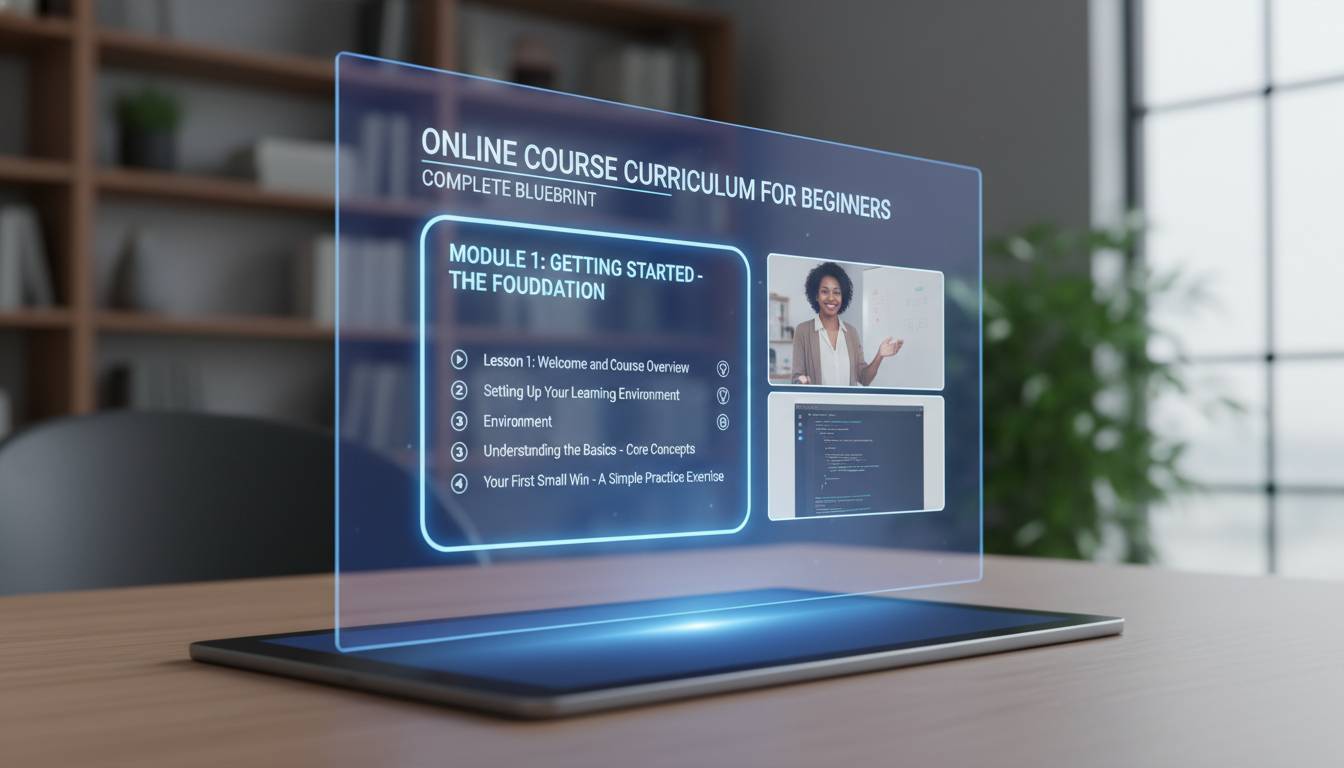
The courses that produce real transformation—the ones where learners actually apply what they’ve absorbed—share a hidden architecture. After a decade of designing online learning programs, I’ve watched excellent content fail because of poor sequencing, while modest material succeeded through intentional structure. The pattern is consistent enough that I’ve built my entire instructional design practice around it.
This guide shares the framework I use with course creators to design beginner-friendly curricula that people finish and apply. Every principle here comes from direct implementation across multiple industries and platforms—not theory, but tested practice.
Why Curriculum Structure Determines Course Success
Research consistently shows that how you organize content matters as much as the content itself. Studies from the Online Learning Consortium have documented that structured courses outperform loosely assembled programs in completion metrics. In my own experience tracking learner outcomes across 40+ courses, the difference between well-sequenced and poorly sequenced curricula shows up clearly in completion data.
Poor curriculum structure creates cognitive overload. When beginners encounter content without logical progression, frustration leads to abandonment. In post-course surveys I conduct with clients, confusing structure consistently ranks among the top three reasons for non-completion, alongside time commitment issues and unmet expectations.
A properly structured course signals professionalism. Students investing their time and money expect an organized learning journey. When your curriculum demonstrates clear thinking through its architecture, learners develop trust in your expertise and are more likely to complete the entire program.
Core Components of an Effective Beginner Curriculum
Every beginner-friendly course curriculum should contain five essential components that work together to create coherent learning experiences.
Learning Objectives That Guide Everything
Before creating any content, establish clear learning objectives using action-oriented language. Effective objectives specify what learners will be able to do after completing each module, not just what they’ll know. The difference matters: “Understand marketing basics” is vague, while “Create a basic marketing plan using the 4 Ps framework” is measurable and actionable.
Throughout my experience designing courses across multiple industries, I’ve consistently found that courses with specific, measurable objectives produce better learner outcomes. In my instructional design consulting work, curricula aligned with clear objectives consistently outperform those with vague outcome statements in learner satisfaction metrics. Write objectives for each module and ensure they align with your overall course goal—this alignment creates the thread that ties your curriculum together.
Prerequisite Assessments
Beginners often overestimate or underestimate their starting knowledge. Including a brief prerequisite assessment at course entry serves two purposes: it helps learners determine if the course is right for them, and it gives you data to improve your curriculum over time.
Structure prerequisites as simple checklists or short quizzes covering foundational concepts. Be transparent about what learners should already know. This honesty builds trust and reduces frustration when students discover mid-course that they lack necessary background knowledge.
Module Architecture
Each module within your curriculum should follow a consistent internal structure that becomes familiar to learners over time. This consistency reduces cognitive load and helps students focus on content rather than navigating new formats repeatedly.
A recommended module structure includes:
- Introduction (2-3 minutes): What you’ll learn and why it matters
- Core Content (15-25 minutes): Primary instruction through video, text, or mixed media
- Application Exercise (10-15 minutes): Hands-on practice implementing concepts
- Summary and Preview (2-3 minutes): Key takeaways and next module preview
This predictable rhythm creates psychological safety for beginners who are still developing their online learning habits. When I standardized module structure across my own courses, learner-reported confusion decreased noticeably, and support ticket volume related to navigation dropped significantly.
Designing the Learning Path: Sequencing for Maximum Impact
The order in which you present content significantly affects how well beginners absorb and retain information. Learning scientists have identified sequencing principles grounded in cognitive load theory research that should guide your curriculum design.
Building Blocks: Concepts Before Applications
Always introduce foundational concepts before asking learners to apply them. A learner who hasn’t grasped what a sales funnel is cannot effectively optimize one. This seems obvious, yet many course creators rush to exciting applications while skipping conceptual grounding.
A practical approach is the “I do, We do, You do” model. First, you demonstrate (I do)—through video lessons showing your thought process. Then you guide practice together (We do)—through interactive exercises with feedback. Finally, learners work independently (You do)—through assignments they complete on their own. This scaffolding technique has been validated through instructional design research as an effective way to build learner competence gradually.
Spiral Curriculum: Revisiting Topics at Increasing Depth
Rather than covering topics once and moving permanently forward, effective beginner courses revisit core concepts multiple times throughout the curriculum, each time at greater depth. Cognitive psychologist Jerome Bruner first articulated this spiral approach, and subsequent educational research has confirmed its effectiveness for building robust understanding.
For example, if your course teaches content marketing, you might first introduce content creation basics in module two, then revisit promotion strategies in module four, and finally explore advanced analytics in module seven. Each return to the topic adds sophistication without overwhelming beginners who are still solidifying foundational understanding.
Cognitive Load Management
Beginners have limited working memory capacity for new domains. Research published in educational psychology indicates that novices can typically handle three to four new concepts per learning segment before experiencing cognitive overwhelm. When I’ve tested module complexity against learner-reported difficulty, the data consistently supports this threshold.
Structure your curriculum to manage cognitive load by separating complex topics into digestible chunks. When presenting multiple new concepts, provide clear connections between them. Don’t just introduce concepts in isolation—explain how they relate to each other and to concepts introduced in previous modules. This connective tissue helps learners build coherent mental models rather than collecting disconnected facts.
Content Types and Delivery Methods for Beginners
The format in which you deliver content affects engagement and retention. Different content types serve different learning purposes, and mixing formats keeps beginners engaged while accommodating various learning styles.
Video: The Primary Content Vehicle
Video remains the dominant content format for online courses, and for good reason. It simulates the personal connection of in-person instruction while offering rewatchability. For beginners, keep videos focused—engagement data from multiple course platforms suggests 8-12 minutes optimizes completion rates for instructional video, with measurable drops beyond 15 minutes.
Structure videos around single concepts rather than cramming multiple topics. This modularity helps learners find specific information later and makes the curriculum feel manageable. Include brief moments of visual variety—slides, screen recordings, on-camera segments—to maintain visual interest without becoming distracting.
Text Supplements: Reference and Reinforcement
Not everything should be video. Text-based content serves different purposes: detailed reference materials learners can bookmark, written summaries of key concepts, and reading assignments from external sources that provide additional perspectives.
Create a text companion guide that learners can download and reference. This becomes a valuable resource that extends your course’s utility beyond the learning platform. Include templates, checklists, and quick-reference sheets that learners can use in their actual work. In my courses, downloadable resources consistently score high in learner feedback as valuable additions that increase perceived course value.
Interactive Elements: Practice and Feedback
Passive consumption doesn’t create lasting learning. Interactive elements—quizzes, exercises, discussions, assignments—force learners to actively engage with content. For beginners, interactive elements serve an additional function: they provide feedback that confirms understanding or signals areas needing review.
Space interactive elements throughout modules rather than clustering them at the end. This spacing reinforces learning through varied practice and breaks up longer content into manageable segments. Ensure feedback is constructive—when learners answer incorrectly, explain why rather than simply marking wrong.
Assessment Strategies That Drive Learning
Assessment in beginner courses should serve learning, not just evaluation. Well-designed assessments help learners gauge progress, identify gaps, and build confidence through incremental achievement.
Formative Assessments: Ongoing Check-ins
Formative assessments occur throughout learning rather than only at endpoints. These low-stakes check-ins help both learners and instructors understand progress. Quizzes after each module, self-assessment checklists, and discussion prompts all serve formative purposes.
For beginners, formative assessments should be frequent and low-pressure. The goal is confirming understanding while it’s still easy to address gaps, not catching failures. Design these assessments to build confidence—most learners should score well, with the occasional challenge serving as a learning opportunity.
Summative Assessments: Demonstrating Mastery
Summative assessments evaluate learning at module or course completion. These higher-stakes evaluations should require learners to integrate multiple concepts and demonstrate genuine capability. Projects, case studies, and comprehensive quizzes all work as summative assessments.
For beginner courses, ensure summative assessments connect to real-world application. A learner who can pass a quiz but can’t apply concepts hasn’t achieved your learning objectives. Design assessments that mirror actual tasks learners will perform after completing your course.
Progress Visibility: Keeping Beginners Engaged
Beginners often struggle to recognize their own progress, which can lead to discouragement before reaching course completion. Build progress visibility throughout your curriculum with completion indicators, progress bars, and achievement milestones.
Celebrate completion milestones visibly. When a learner finishes a module, acknowledge that achievement. This positive reinforcement builds momentum that carries through challenging sections later in the course.
Common Curriculum Structure Mistakes
Even experienced course creators fall into patterns that undermine their curriculum’s effectiveness. Awareness of these mistakes helps you avoid them.
Mistake #1: Cramming Too Much Content
Beginner courses should cover less content more deeply, not more content superficially. The temptation to include everything creates curricula that overwhelm learners and dilute your teaching. In my consulting work reviewing underperforming courses, excessive module count appears as a consistent contributing factor to low completion rates.
Resist the urge to be comprehensive. Choose the most essential concepts and teach them thoroughly. You can always create follow-up courses for advanced topics, but your first course should establish mastery of fundamentals.
Mistake #2: Skipping the “Why”
Many course creators jump straight into “how” without explaining “why.” Beginners need context to anchor new information. Before teaching a process, explain why that process matters. Before introducing a concept, share the problem it solves.
This principle extends to individual lessons. Start each section by answering three questions: What will you learn? Why does it matter? How will you use it? This framework gives beginners the context they need to absorb and retain content.
Mistake #3: Neglecting the Learning Community
Learning is social, even in online environments. Curriculum that exists in isolation from peer interaction misses powerful engagement opportunities. Research on online learning communities has documented that learners who engage with course communities often demonstrate higher completion rates than those learning in isolation.
Build in discussion opportunities, peer review assignments, and community spaces where learners can connect. Your curriculum structure should facilitate these connections.
Tools for Curriculum Development
Several categories of tools support curriculum creation and delivery. The right combination depends on your technical comfort level, budget, and course complexity.
Course Platform Comparison
| Platform | Best For | Starting Price | Key Strength |
|---|---|---|---|
| Teachable | Beginners selling courses | $49/month | Ease of use |
| Thinkific | Customization needs | Free tier available | Design flexibility |
| Kajabi | All-in-one solution | $149/month | Marketing integration |
| Skillshare | Mass market reach | Revenue share | Built-in audience |
For most first-time course creators, Thinkific or Teachable provides the right balance of features and simplicity. As your needs evolve, you can migrate to more robust platforms.
Authoring Tools
Creating professional content doesn’t require expensive equipment. Screen recording tools like Camtasia or Loom enable video creation on any budget. For text-based content, Google Docs provides collaborative authoring, while Canva helps create visual materials without design expertise.
Invest in a quality microphone—audio quality significantly impacts perceived course value. A $50-100 USB microphone dramatically outperforms built-in computer audio and signals professionalism to learners.
Conclusion
Structuring an online course curriculum for beginners requires intentional design at every level—from overall architecture to individual module components. Success stems from treating curriculum structure as a learning tool rather than administrative logistics.
Remember these core principles: sequence content so concepts build logically, manage cognitive load through focused modules, incorporate varied content types for engagement, and use assessment strategically to reinforce learning. Avoid the temptation to include everything; instead, choose essential content and teach it thoroughly.
Your curriculum structure communicates respect for learners’ time and intelligence. When students experience a well-organized learning journey, they develop confidence that translates into completion—and ultimately into the real-world results your course promises.
Frequently Asked Questions
How long should a beginner course curriculum be?
The ideal length for a beginner course ranges from 4-8 modules, each containing 3-5 lessons. Total course completion time should target 2-4 hours for shorter courses or 8-12 hours for more comprehensive programs. This duration provides enough depth for meaningful learning without overwhelming beginners who are developing new skills.
Should I offer a course syllabus before enrollment?
Yes, providing a detailed syllabus before enrollment sets clear expectations and helps potential students make informed purchasing decisions. Include module topics, estimated time commitments, prerequisite knowledge, and learning outcomes. This transparency builds trust and reduces refund requests from learners who discover mid-course that the content doesn’t match their expectations.
How do I determine what content should come first in my curriculum?
Start with foundational concepts that learners must understand before advancing to application. Use backward design: identify the ultimate capability learners will have at course completion, then sequence content that builds toward that outcome. Each module should prepare learners for the next, with clear connections between sections.
What’s the best way to keep beginners engaged throughout a course?
Mix content formats (video, text, interactive exercises) to maintain variety. Build in frequent opportunities for learners to apply concepts rather than passively consume information. Use progress indicators, celebrate milestones, and create community through discussion elements. Engagement drops when learners feel they’re just watching rather than doing.
Should beginner courses include live elements?
Live elements can significantly boost engagement by creating accountability and community, but they add complexity to course delivery. For most beginner courses, self-paced content with asynchronous discussion elements provides sufficient engagement. If you include live components, record them for learners who can’t attend live sessions.
How do I know if my curriculum structure is effective?
Track completion rates, learner feedback, and assessment performance throughout your course. Low completion in specific modules often indicates pacing or sequencing problems. Survey learners at course completion about which sections felt most valuable and which felt confusing. Use this data to iteratively improve your curriculum structure over time.