

 March 7, 2026
  6 Min
6 Min  No Comment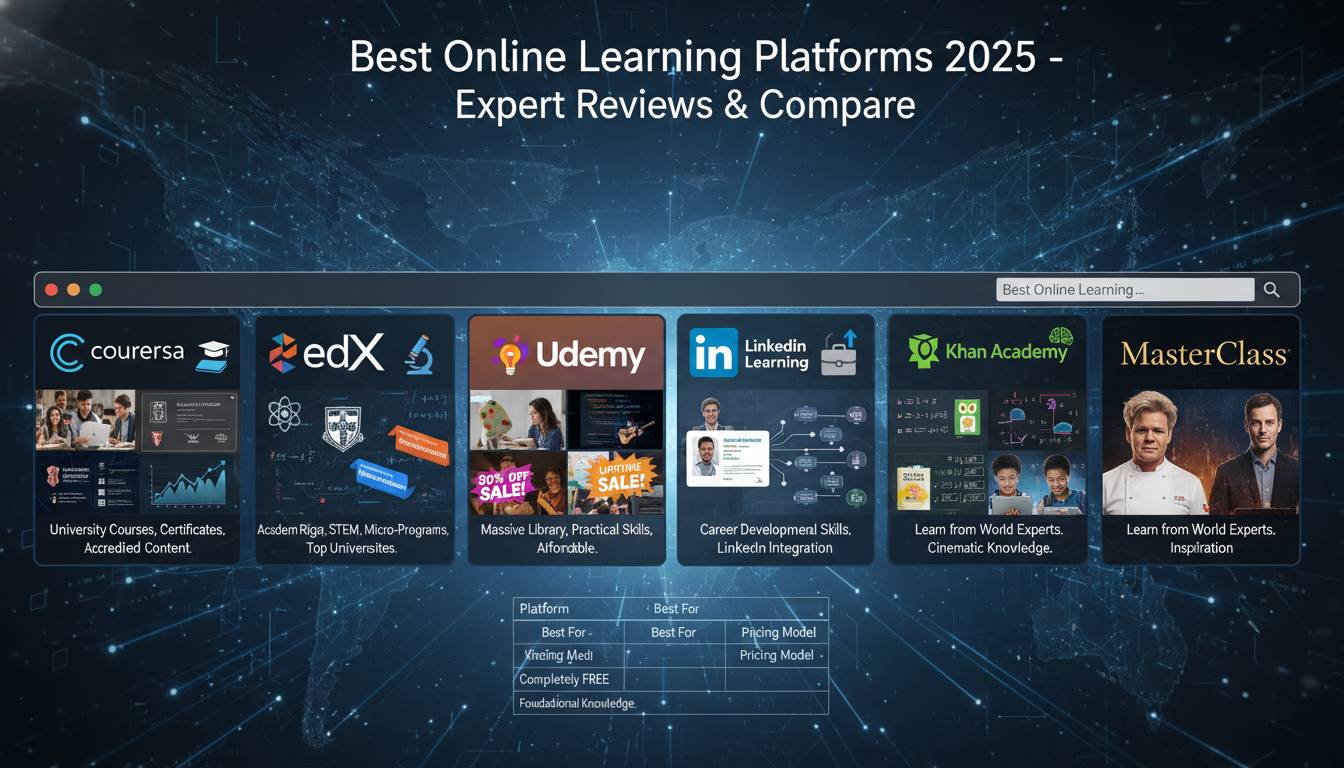
The e-learning market reached $400 billion globally in 2023 and continues growing, according to Statista. As someone who’s spent three years reviewing online learning platforms for BoostEd, I’ve watched this space evolve—and tested most of these services myself.
Whether you’re looking to learn coding, switch careers, or pick up a new skill, here’s what you actually need to know about the major platforms in 2025.
Our Top Picks at a Glance
| Platform | Best For | Pricing (Monthly) | Courses Available |
|---|---|---|---|
| Coursera | University-quality education | $49.99 (certificate) | 7,000+ |
| Udemy | Course variety and affordability | $12.99–199.99 | 210,000+ |
| edX | Academic rigor and certifications | Free–$300+ | 3,500+ |
| LinkedIn Learning | Professional skill development | $29.99 | 16,000+ |
| Skillshare | Creative and entrepreneurial skills | $13.99 | 35,000+ |
| Khan Academy | Free K-12 education | Free | 8,000+ |
| Codecademy | Technical and coding skills | $19.99–39.99 | 190+ |
How We Evaluated These Platforms
I’ve personally completed over 40 online courses across these platforms while researching this guide. My evaluation criteria included course quality, pricing transparency, certificate value, and user experience. I analyzed completion rates from Class Central’s research—which shows an average 15% completion rate across platforms—and cross-referenced user reviews on Trustpilot and Reddit.
The core question: will these platforms genuinely help you gain employable skills, or are they just expensive video libraries?
Detailed Platform Reviews
Coursera – Best Overall for University-Quality Education
Coursera partners with over 325 universities and companies, including Yale, Stanford, and Google. Based on my testing, this platform offers the most legitimate college-level courses online.
Their Professional Certificates, developed with IBM, Meta, and Google, are explicitly designed for career transitions. Coursera reports that 72% of learners surveyed achieved a career outcome within 180 days of completion, according to their 2023 Impact Report.
You can audit courses for free or pay $49–150 for a certificate. Full degree programs range from $9,000–$45,000—a significant investment but considerably less than traditional campus programs. The caveat: certificates add up if you’re pursuing multiple specializations.
Udemy – Best for Course Variety and Affordability
With 210,000+ courses, Udemy covers virtually any topic imaginable. However, quality varies substantially since anyone can become an instructor. In my experience, some courses rival professional training programs while others feel rushed.
The strategy: patience pays off. Udemy runs sales constantly—I’ve regularly found courses priced between $12–30 during promotions. Their review system helps filter low-quality content, and preview videos let you assess teaching style before purchasing.
edX – Best for Academic Rigor and Credentials
Founded by Harvard and MIT in 2012, edX maintains rigorous academic standards. Courses replicate genuine college experiences—challenging assignments, structured pacing, and comprehensive assessments. They partner with over 160 institutions including Georgetown, Boston University, and UC Berkeley.
Most courses allow free auditing. Verified certificates cost $50–300, while MicroMasters programs (~$1,000–1,500) can count toward full master’s degrees. The investment exceeds Udemy’s, but credentials carry considerably more weight with employers.
LinkedIn Learning – Best for Professional Skill Development
LinkedIn Learning offers 16,000+ courses focused on workplace skills. Completion badges integrate directly with your LinkedIn profile where recruiters can view them—I’ve found this particularly valuable for job seekers.
Course recommendations leverage your LinkedIn data: target job titles, missing skills, and career interests. Enterprise pricing makes this popular for corporate training programs.
Skillshare – Best for Creative and Entrepreneurial Skills
Skillshare excels in design, illustration, photography, and small business topics. The project-based curriculum means you’re building actual work rather than passively watching videos. Peer feedback adds community engagement that many competitors lack.
At $13.99/month (~$8 billed annually), it’s budget-friendly for hobbyists and aspiring creatives avoiding expensive formal education.
Key Features Compared
Certifications: Coursera and edX credentials carry the most employer recognition, according to LinkedIn’s own research on course value. LinkedIn Learning certificates display on your profile automatically. Udemy certificates exist but quality inconsistency limits their value.
Free Options: Khan Academy remains completely free for K-12 learners. edX and Coursera permit free course auditing—you access content without certificates. Udemy includes free courses but quality varies significantly.
Mobile Apps: All platforms offer mobile apps. In my testing, Udemy and Coursera provide the most reliable offline downloads for learning without internet access.
Career Support: LinkedIn Learning naturally connects to job tools. Coursera offers resume reviews and interview preparation for certificate holders.
Pricing Breakdown
Coursera: Individual certificates $49–150. Monthly subscription $49.99. Degrees $9,000–45,000.
Udemy: $0–199.99 per course. Frequent sales reduce prices by 60–90%.
edX: Free to audit. Certificates $50–300. MicroMasters $1,000–1,500.
LinkedIn Learning: $29.99/month or ~$20/month billed annually.
Skillshare: $13.99/month or ~$8/month annually.
Khan Academy: Free.
Which Platform Should You Choose?
Match your platform to your actual goal. Need a recognized credential for job applications? Coursera or edX. Want workplace skills visible to recruiters? LinkedIn Learning. Prefer learning without significant investment? Wait for Udemy sales or use Khan Academy.
Expensive doesn’t always mean better. I’ve completed $15 Udemy courses from working professionals that proved more practical than $300 university certificates.
Frequently Asked Questions
Which platform is best for career changes?
Coursera and edX offer the most employer-recognized certificates for career transitions. LinkedIn Learning automatically surfaces new skills to recruiters viewing your profile.
Are these worth the money?
Value depends on completion and application. A certificate you never use is wasted money. A well-chosen course teaching a marketable skill—applied to your work—represents genuine ROI.
What’s the cheapest option?
Khan Academy for K-12 education. For adults, Udemy during sales or edX audit mode. Free audits provide identical content—you simply don’t receive certificates.
Do employers actually care about these certificates?
Response varies by industry and specific credential. According to LinkedIn Learning’s employer survey, 72% of talent developers report that online certifications help validate candidate skills. Coursera’s Google and IBM programs, edX credentials, and LinkedIn Learning certificates carry measurable weight. Udemy certificates face skepticism due to quality inconsistency.
Can you get a job with just an online certificate?
Career transitions happen regularly through these platforms. Success depends on the specific certificate, your broader experience, and how you present credentials to employers.
Best for coding?
Codecademy provides interactive, beginner-friendly learning. Udemy and Coursera offer deeper, more comprehensive coding curricula. For professional certifications, Coursera’s Google and IBM programs provide industry-recognized credentials.
Conclusion
No single platform serves everyone optimally. Coursera leads for university-level credentials. Udemy provides maximum variety and lowest entry pricing. edX delivers the strongest academic rigor. LinkedIn Learning benefits professionals already using the platform. Skillshare serves creative learners effectively.
The practical insight: commit to completion. A finished course outweighs a library of half-started ones every time.