

 March 7, 2026
  7 Min
7 Min  No Comment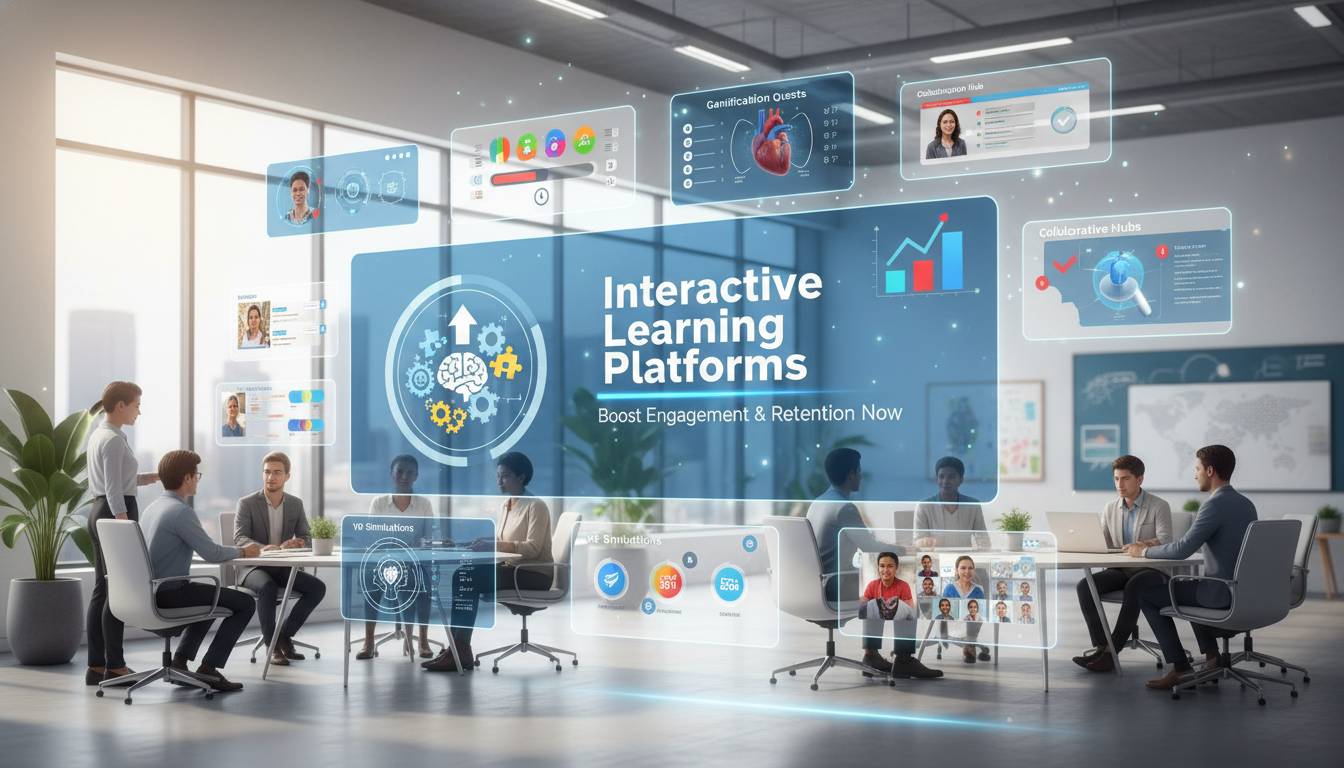
Over the past decade, interactive learning platforms evolved from basic video hosting into environments combining adaptive algorithms, game-like mechanics, analytics dashboards, and collaboration tools. In my experience reviewing enterprise learning solutions, this transformation has reshaped how organizations approach workforce development and education. Organizations ranging from elementary schools to Fortune 500 companies now use these platforms to move beyond passive content consumption.
Educational research consistently supports this shift. A landmark meta-analysis published in the Proceedings of the National Academy of Sciences examined 225 studies involving over 50,000 students and found that active learning increased exam scores by an average of 6 percentage points (Freeman et al., 2014). Interactive learning platforms operationalize these findings at scale.
The global digital learning market reflects this momentum. According to market research firm HolonIQ, the global EdTech market reached $341 billion in 2023 and continues growing at double-digit rates annually. This article covers what interactive learning platforms do, which features actually affect outcomes, and how to select one that fits your situation.
What These Platforms Actually Do
Interactive learning platforms are software designed to move learners beyond watching or reading. The core principle, backed by decades of cognitive science research: people retain more when they actively engage with material—answering questions, solving problems, participating in simulations, discussing with peers, or manipulating virtual environments.
This approach draws from constructivist learning theory, which educational researchers developed throughout the 1970s and 1980s. The foundational work by psychologists like Jean Piaget and Lev Vygotsky established that learners build understanding by actively constructing knowledge rather than passively receiving information.
Today’s platforms run on cloud infrastructure, work across mobile devices, use AI for personalization, and support multimedia capabilities that weren’t technically feasible fifteen years ago. In the US, adoption spans K-12 schools, universities, corporate training, healthcare compliance, professional certifications, and independent creators selling courses online.
The COVID-19 pandemic forced rapid digital adoption across education and training sectors. Organizations that previously resisted digital transformation discovered that interactive features often produced superior outcomes compared to static videos or documents—confirming what educational research had demonstrated for years.
Features Worth Prioritizing
The platforms that consistently deliver results share capabilities that demonstrably affect learning outcomes.
Adaptive learning uses algorithms to adjust difficulty and pacing based on individual learner performance. This addresses a persistent challenge in traditional classroom and e-learning settings: identical content that moves too fast for some learners and bores others.
Gamification adds points, badges, leaderboards, or progress tracking. A meta-analysis published in Computers & Education (Landers, 2014) examined 92 studies and found that well-implemented gamification can improve learning outcomes significantly. The critical caveat: implementation quality determines results. Poorly designed gamification can feel gimmicky or create counterproductive competition dynamics.
Analytics provides instructors with dashboards showing more than test scores. Meaningful data includes time spent on modules, where learners encounter difficulties, engagement patterns, and early warning indicators that someone might not complete requirements. Some platforms now use natural language processing to analyze discussion posts or written assignments, delivering feedback that previously required human grading.
Feature prioritization depends on your specific context. A company running compliance training requires different capabilities than someone building a paid course business. The following sections examine specific platforms and their strengths.
Platform Options Worth Considering
Several platforms have established strong reputations through consistent execution and user satisfaction. User reviews on G2 and Capterra consistently identify the same leading options.
TalentLMS works well for small to mid-sized businesses seeking an affordable platform without feature compromises. The interface is clean and doesn’t require technical expertise. It handles multiple content types—SCORM packages, video, PDFs, interactive presentations—and offers a free tier for small teams. Costs scale with user count and storage needs.
LearnWorlds targets course creators who want to build and monetize programs. Social learning features enable learner interaction and collaboration. The built-in website builder allows creators to establish branded sites alongside courses. Interactive video features, which let creators embed questions and links directly in videos, receive consistently positive reviews.
Thinkific positions itself as the most beginner-friendly option for course creation. The platform has served over 100,000 creators and processed substantial course sales through its marketplace. A free tier lets creators start without upfront costs, with revenue-sharing beginning only after initial sales.
Kajabi operates at the premium end, bundling course creation with website building, email marketing, and customer relationship management. This works well for entrepreneurs or established brands building complete educational businesses, though the price point exceeds what most individual creators can justify.
Teachable (owned by General Assembly’s parent company) sits between Thinkific and Kajabi in both features and pricing. Recent investments in AI tools help creators optimize content and improve learner outcomes.
Other options worth exploring include Docebo (strong in enterprise settings), Absorb (popular in corporate training), and Zippy (built specifically for compliance training).
How to Pick the Right One
The “best” platform depends entirely on context. Different goals, budgets, and technical situations point toward different solutions.
Start with objectives. Are you delivering compliance training requiring documented completion records? Running for-credit curriculum? Selling courses as a business? Sharing knowledge internally among employees? Each goal emphasizes different capabilities.
Look beyond the subscription price. Implementation costs—content migration, customization, integrations with existing HR or student systems—can exceed platform fees themselves. Admin and instructor training adds additional expense, especially for complex tools. Storage overages, premium feature access, and per-user pricing can surprise organizations as programs scale.
Assess technical reality. If your team lacks developer resources, prioritize platforms that work well out of the box. If you have technical capacity, API access and customization options become more valuable. Mobile accessibility has become essential—test thoroughly if learners will use phones or tablets. Integration with existing systems (single sign-on, HR platforms, student information systems) and compliance with regulations like FERPA or HIPAA may be non-negotiable depending on your context.
Use free trials seriously. Test the actual workflows your team will use daily. Evaluate not just features but customer support quality and platform responsiveness to issues.
What You’ll Actually Pay
Most platforms charge per active learner or per seat, with tiered pricing that reduces per-user costs at higher volumes. This aligns costs with usage but creates budgeting challenges when enrollment fluctuates.
Some platforms charge flat fees regardless of user count, which works better for large training populations but can represent overpayment for smaller programs.
Free tiers exist for most platforms—use them to test before committing. Money-back guarantees reduce risk for annual commitments.
One expense that catches organizations off guard: content creation. Building quality interactive courses often costs more over time than platform subscriptions themselves. Factor in instructional designers, media production, and subject matter expert involvement when calculating total investment.
Where Things Are Heading
AI features are expanding beyond basic personalization. Automated content generation, real-time translation for global audiences, and intelligent tutoring systems that provide one-on-one guidance are becoming standard capabilities. Machine learning is improving at predicting learner outcomes and recommending optimal learning paths.
Virtual and augmented reality are emerging in fields where hands-on practice matters most—medical training, hazardous material handling, equipment operation. Headset costs and content development complexity have limited adoption, but browser-based VR is lowering barriers.
The boundary between learning platforms and collaboration tools continues blurring. Modern platforms increasingly integrate with productivity software, enabling learners to access training within their actual work flows rather than visiting separate portals.
Common Questions
What’s best for small businesses?
TalentLMS and GoSkills rank well for small teams due to reasonable pricing, straightforward interfaces, and feature sets that don’t require dedicated technical staff to manage.
Do these platforms actually improve corporate training?
Research confirms interactive elements boost training effectiveness. A meta-analysis in the Journal of Computing in Higher Education found roughly 6% improvement in test scores on average, with substantially higher completion rates compared to passive content (Bernard et al., 2014).
Typical cost range?
From free tiers for small teams to enterprise systems costing tens of thousands annually. Most commercial platforms fall between $15 and $100 per learner per month, with meaningful discounts for annual billing.
Can I create my own content?
Yes. Most platforms include authoring tools designed for non-technical users. Complex elements like simulations or branching scenarios may require instructional designers or specialized tools.
Do they work on mobile?
Most offer mobile-responsive designs or dedicated apps, but mobile experience quality varies significantly. Test during trial periods if mobile access is important for your learners.
What matters most for compliance training?
Look for robust tracking and reporting capabilities, HR system integration, completion certification, and offline access options for workers without reliable internet connectivity.