

 February 9, 2026
  4 Min
4 Min  No Comment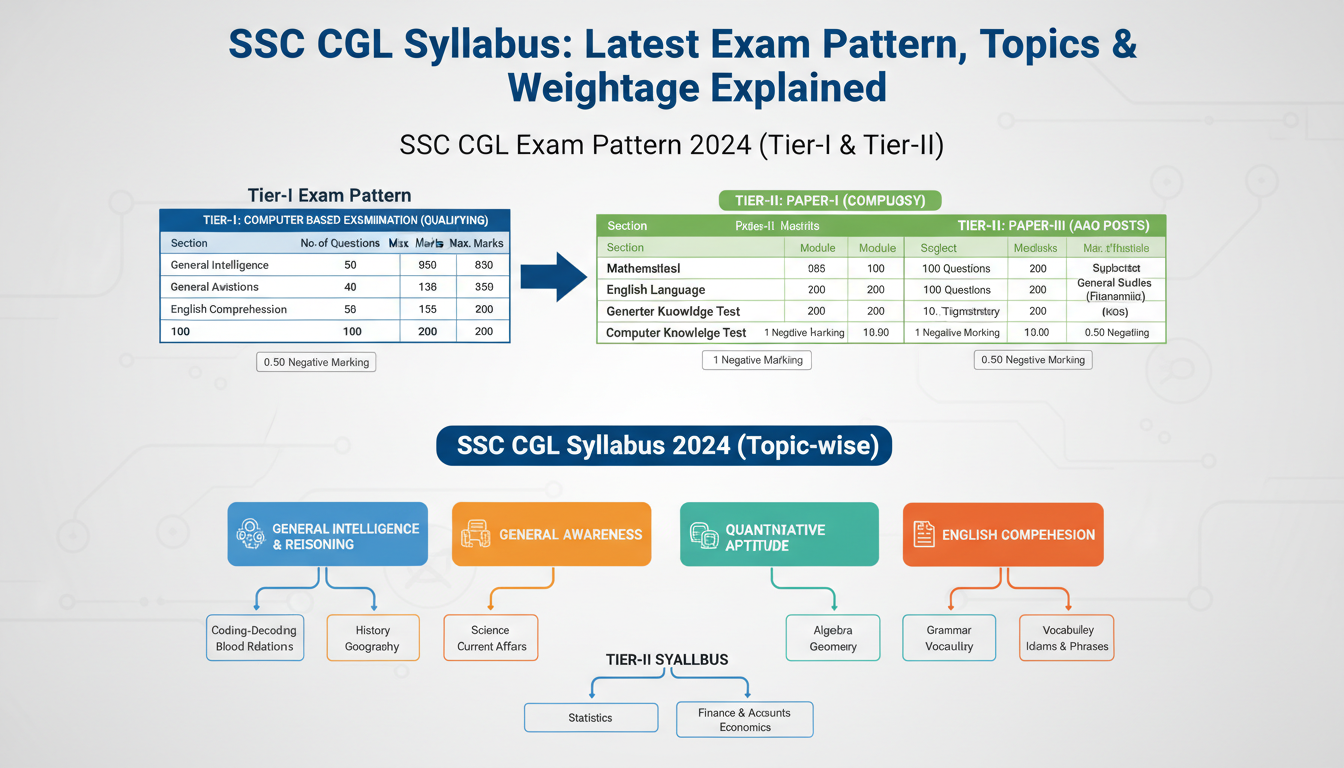
The SSC CGL syllabus for 2025 covers both Tier 1 and Tier 2 stages, with a well-defined structure, core topics, and weightage that orient your focus. Here’s a clear breakdown including how many questions you can expect from each section and what’s most important.
Tier 1: Foundation of SSC CGL 2025
Tier 1 is the entry-level exam and acts as a screening round to advance to Tier 2. It tests four key areas equally.
Exam Pattern at a Glance
- Format: Computer-based test with 100 MCQs.
- Sections: General Intelligence & Reasoning (25 Qs), General Awareness (25 Qs), Quantitative Aptitude (25 Qs), English Comprehension (25 Qs).
- Total Marks: 200 (2 marks per question), Duration: 60 minutes.
- Negative marking: ‑0.5 marks for each wrong answer.
Key Topics & Weightage
Quantitative Aptitude
Focus areas include geometry, data interpretation (DI), trigonometry, algebra, profit & loss, ratio, and number system. Geometry and DI alone contribute approximately 4 questions each per session.
General Awareness
History, current affairs, geography, economics, and polity dominate this section. History and current affairs typically average 4 and 3–4 questions respectively per session.
Reasoning
High-yield topics include coding-decoding, odd one out, number sets, visual reasoning (mirror images, figure series), mathematical operations. These often appear around 2–3 times each.
English Comprehension
Close test, error detection, synonyms/antonyms and fill-in-the-blanks are critical. Close test and error detection alone may account for 5+ and 4+ questions per session.
Tier 2: Deep Dive into Merit-Based Marks
Tier 2 matters most for your final ranking. It includes two papers for all candidates, plus a Statistics paper for select posts like JSO.
Paper I Structure
Paper I splits into multiple modules across two sessions:
– Mathematical Abilities (30 Qs, ~23%, 90 marks)
– Reasoning & General Intelligence (30 Qs, ~23%, 90 marks)
– English Language & Comprehension (45 Qs, ~35%, 135 marks)
– General Awareness (25 Qs, ~19%, 75 marks)
– Computer Knowledge Test (20 Qs, 60 marks, Qualifying)
– Data Entry Speed Test (DEST) (Qualifying)
Paper II (If Applicable)
For roles like JSO or Statistical Investigator:
– Paper II: Statistics – 100 questions, 200 marks, 2 hours.
Negative Marking
- Paper I: ‑1 mark for incorrect answers.
- Paper II (Statistics): ‑0.5 mark per wrong answer.
Detailed Topic Coverage for Tier 2
Mathematical Abilities & Reasoning
Expect advanced questions across number systems, algebra, geometry, trigonometry, DI, and statistics. The reasoning portion remains focused on pattern-based and logical reasoning.
English Language & Comprehension
Reading comprehension, grammar (error correction, fill-in-the-blanks), vocabulary (synonyms, antonyms), para jumbles, and narration feature heavily.
General Awareness
The syllabus expands to include scientific developments, environmental concepts, Indian polity, and current national/international events.
Expert Insight & Real-World Prep Strategy
“Understanding question distribution helps you study smart, not just hard. Focus on high-frequency topics and you’ll pay dividends on exam day.”
Seasoned aspirants repeatedly stress covering high-yield topics like DI, geometry, coding-decoding, and error detection. One candidate’s math plan focused intentionally on simplification, percentages, trigonometry, and DI to maximize returns.
Why This Syllabus Map Beats Generic Guides
You get fresh patterns from 2024–25 data, like exact averages per topic per shift and merit-based structure statistics. Unlike vague lists, this spells out what to prioritize—geometry over averages, RC over idioms. It comes with negative marking caveats, Computer Knowledge and DEST qualifying insights, and case-backed strategy. No fluff. All action.
Summary: Strategy Recap
- Tier 1: Practice geometry, DI, coding-decoding, error spotting, and current affairs first.
- Tier 2: Deepen your math and reasoning, nail comprehensive English, stay updated in GK, and clear the Computer test comfortably.
- Paper II (Stats): Only relevant if you’re targeting stats-specific posts; approach it with focused math-stats practice.
Regular mocks, timed practice, and topic prioritization based on weightage yield the most impact.
FAQs
What’s the negative marking in Tier 1 and Tier 2?
Tier 1 has ‑0.5 marks for wrong answers. In Tier 2, Paper I deducts 1 mark per wrong answer, while Paper II deducts 0.5 marks.
Which topics carry the highest weight in Tier 1 Math?
Geometry and Data Interpretation are top priorities, each yielding around 4 questions per shift on average.
Is Computer Knowledge important for Tier 2?
Yes, it’s a qualifying section in Paper I. You must clear it, but marks don’t contribute to final merit.
Do all candidates go to Paper II?
No—Paper II is only required for select roles such as Junior Statistical Officer or Statistical Investigator.
How should I prioritize revision?
Start with high-weightage areas: for Tier 1, focus on geometry, coding-decoding, error spotting; for Tier 2, lean into RC, advanced DI, comprehensive GK, and computer basics.
This breakdown equips you with clarity, structure, and actionable direction for excelling in SSC CGL 2025.
