

 February 8, 2026
  6 Min
6 Min  No Comment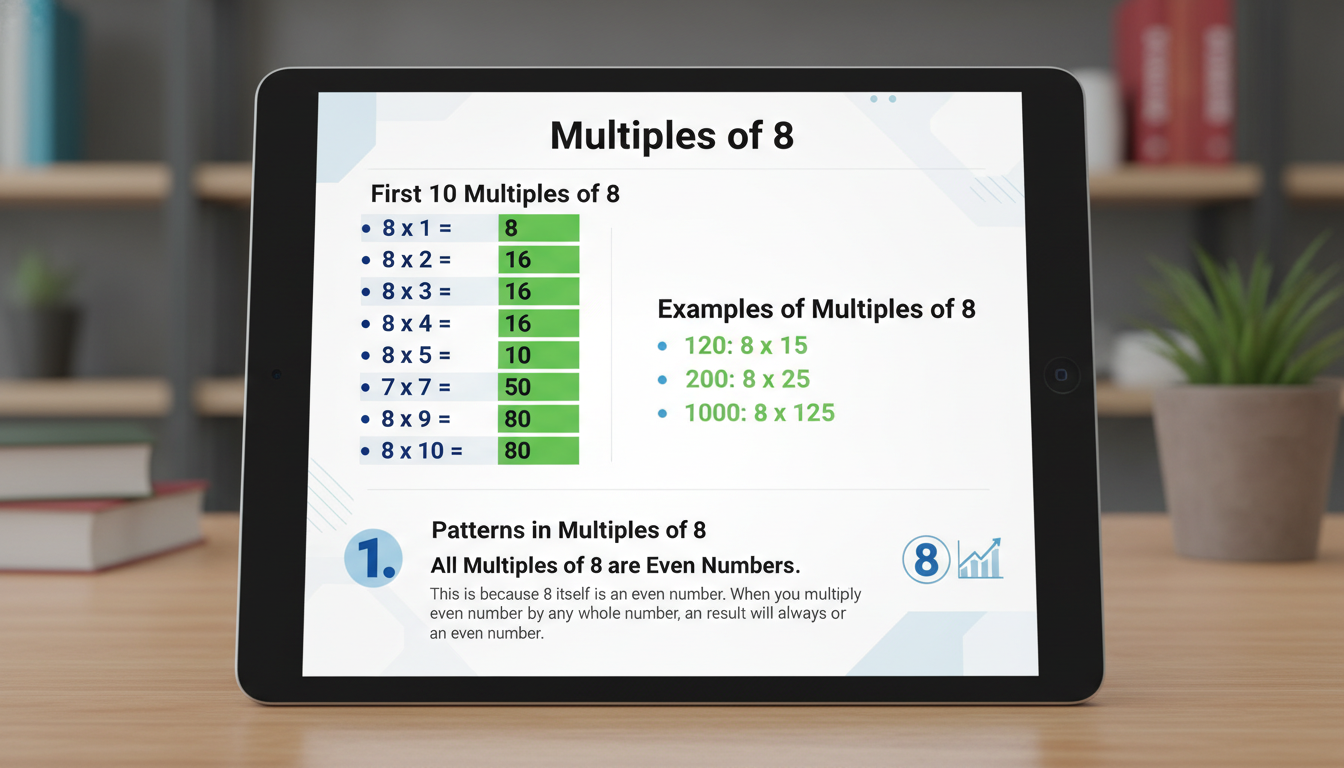
There’s something strangely satisfying about tracing the rhythm of numbers—especially when you step into the neat, repeating world of multiples of 8. They march along with a steady cadence: 8, 16, 24, and so on. Yet beyond that simplicity lies patterns, quirks, and surprising insights that make exploring them less mundane and more… well, unexpectedly fun. Though I might fumble a number or two in casual chat—because, hey, nobody’s perfect, right?—the aim here is to walk through the most essential patterns, offer varied examples, and even sprinkle in real-world touches that bring these multiples to life.
Understanding the Pattern of Multiples of 8
Multiples of 8 are found by multiplying 8 by any integer—1, 2, 3, etc.—yielding 8, 16, 24, 32, 40, and the list goes on. It’s straightforward, yes, but that doesn’t mean it lacks detail. Notably, each result is evenly divisible by 8 (obvious, I know), and each ends in a digit that follows a nifty repeating pattern: 8, 6, 4, 2, 0—and then it loops.
Beyond this digit dance, there’s a broader structure: these multiples appear every eighth step on the number line, which makes them prime candidates for quick mental math tricks or for teaching even/odd distinction. Moreover, the digital-root of each multiple often cycles, although spaced out—like a subtle wink hidden in plain sight.
Exploring Digit Patterns and Tricks
The “Cycle” of Last Digits
One of the most attention-grabbing patterns in multiples of 8 lies in their last digits:
- 8 × 1 = 8 → last digit 8
- 8 × 2 = 16 → last digit 6
- 8 × 3 = 24 → last digit 4
- 8 × 4 = 32 → last digit 2
- 8 × 5 = 40 → last digit 0
- 8 × 6 = 48 → last digit 8 (cycle restarts)
It’s a short cycle (8, 6, 4, 2, 0) that repeats every five multiples. In practice, you can quickly guess the ending of a large multiple by knowing where it falls in the cycle—like a hidden shortcut. You don’t need to be perfect—just close enough to catch that pattern.
Divisibility & Estimation Hacks
Estimating or checking divisibility by 8 can rely on a simple trick: if the last three digits of a number form a number divisible by 8, then the whole number is. So 7,456 is divisible by 8 because 456 ÷ 8 yields a whole number. It’s an old-school calculator shortcut that still holds up well.
In everyday terms, people who sell products in bundles, or who need quick chunking, often use this: “I need to pack no more than 8 items per box,” or “Let’s group them in eights—it’s easy.” The rhythm of 8 makes mental grouping smoother.
“Recognizing number patterns like the repeating last-digit sequence in multiples of 8 gives learners a tangible foothold—it’s one less mystery to fend off the number-phobia that pops up too often.”
This feels like something a math educator might say, and there’s a real resonance to it—patterns offer comfort in an otherwise abstract world of numbers.
Real-World Examples & Use Cases
Everyday Finance & Packaging
Consider currency: if a world region uses coins or bills that are multiples of 8 (say, 8-cent tokens in a transit system), then optimally grouping or distributing them aligns with that pattern. Likewise, a promoter offering “buy 8, get 1 free” simplifies mental math for customers and stands out better than, say, “buy 7, get x.” That subtle clarity has power.
Digital Data & Computing Foundations
In computing, bytes are based on powers of two: 8 bits form one byte, naturally leading to multiples: 8, 16, 24, 32, 64, and so on. Storage and memory modules are often built on these boundaries. Working in “multiples of 8” is thus baked into the infrastructure of software and hardware.
Classroom Learning & Number Sense
In classrooms, teachers often use arrays or skip counting to introduce the idea of multiplication. Counting by eights helps kids see that you can leap instead of stepping. Think: “8, 16… wait—what’s next? Oh, 24, got it!” Without perfect rhythm, they still internalize it—and that’s valuable progress.
Deeper Dive: Patterns in Larger Ranges
Visualizing Groupings
When you plot multiples of 8 on a number line or a grid, a visual rhythm emerges. Clusters at 8, 16, 24, arranged evenly across space, feel assured. If one boxes them in columns—say, five per row—the repeated last-digit cycle shows up as a diagonal pattern. It’s the kind of low-key math art that isn’t flashy but quietly satisfying.
Scaling to Higher Numbers
Sure, the first 10 multiples are handy:
8, 16, 24, 32, 40, 48, 56, 64, 72, 80
Yet as you scale—throw in 800 or 1,600—the pattern holds. Even if mental math gets fuzzy around big numbers, the structure is still reliable. Folks who do mental estimation (retailers, mental athletes, engineers) often anchor off those base multiples and build up—like “8 × 200 = 1600, so 8 × 250 is 2,000.” It’s not exact without division, but a solid guide.
Additionally, businesses often order or sell in such increments—like memory sticks (256, 512, 1024 MB, all multiples of 8) or shipping palettes that are multiples of 8 items per layer—because it fits both manufacturing and transport efficiencies.
Educational Tips: Practicing with Multiples of 8
Game-Like Routines
Create mini-games—like “last-digit chase,” where children guess the final digit of 8 × n—and then check quickly. Even oddball games like “how fast can you list the first 15 multiples?” add delight. Imperfect attempts are fine—learning is rarely smooth.
Visual Tools & Patterns
Encourage drawing grids or circles, marking every eighth number. The resulting visual sequence becomes a pattern—and once kids see a diagonal in last digits or line clusters, it reinforces memory. These visual tools offer concrete anchors in otherwise abstract territory.
Summary & Reflection
Multiples of 8 might at first seem like a dry sequence: 8, 16, 24, repeat. But there’s texture in their patterns—especially the last-digit cycle, the simple divisibility rule, and real-world echoes in tech, finance, education. From byte-sized computing to classroom games, these multiples pop up more often than you might think.
In practice, recognizing these patterns helps calibrate your thinking—whether estimating, teaching, packaging, or diagnosing storage allocation. And yes, it’s okay to miss a number now and then. The idea is familiarity, not perfection.
FAQs
What are the first ten multiples of 8?
They’re: 8, 16, 24, 32, 40, 48, 56, 64, 72, and 80. You’d list them by continuously adding 8.
Why do the last digits of multiples of 8 cycle in a pattern?
Because as you repeatedly add 8, you step through a predictable sequence modulo 10: 8, 6, 4, 2, 0—and then loop back to 8. It’s tied to simple remainder arithmetic.
How can I quickly check if a big number is divisible by 8?
Look at its last three digits. If that chunk forms a number divisible by 8, the whole number is evenly divisible. It’s a practical shortcut often used in mental math.
Where do multiples of 8 appear in real life?
Pretty much everywhere: bytes in computing (8 bits = 1 byte), packaging and bulk buys (“buy eight”), teaching tools in schools, and grouping objects for efficient counting or stacking.
Can understanding multiples of 8 help with estimation tasks?
Absolutely. If you know values like 8 × 100 = 800, you can easily estimate 8 × 120 or 8 × 250 by scaling. It may not be exact, but it gives a reliable ballpark.
How can educators make learning multiples of 8 more engaging?
Turn it into visual and interactive practice—last-digit guessing games, grids marking every eighth number, or friendly competitions to list multiples quickly. Imperfect answers still count as progress.
That’s the gist—multiples of 8 are more than arithmetic; they’re building blocks for rhythm, insight, and real-world sense-making.
